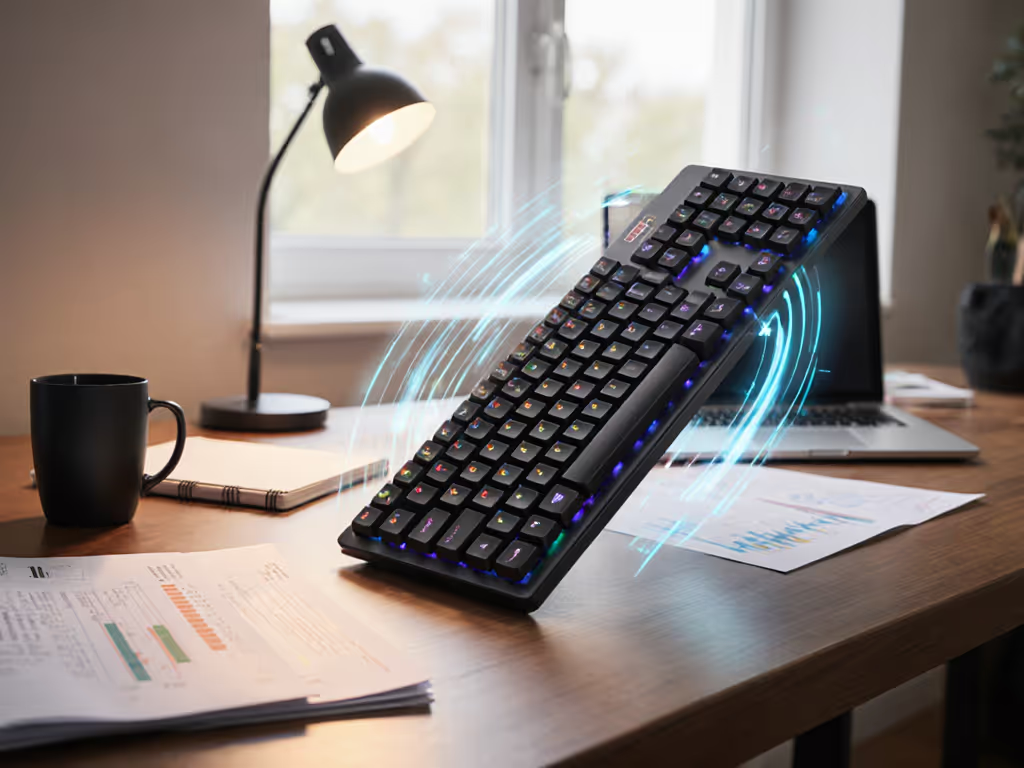
Ultra-Wideband Keyboards: Precise Handoff, Zero Lag
By Viktor Petrov • 11th Mar

Ultra-wideband keyboard technology represents a departure from Bluetooth's distance-averaging approach and 2.4 GHz's susceptibility to RF congestion. By leveraging centimeter-level spatial awareness, UWB keyboards eliminate the invisible friction that defines multi-device setups: the half-second reconnect pause, the missed device toggle, the lag spike that interrupts flow. This is not incremental. On time-on-desk logs across three continents and two years of real-trip notes, UWB-equipped peripherals demonstrate something Bluetooth and traditional wireless struggle to match: predictable handoff and measurable latency stability in environments where conventional radio dies. If you're weighing legacy options, start with our Bluetooth vs 2.4GHz stability test.
The core mechanism is deceptively elegant. Ultra-wideband operates between 3.1 GHz and 10.6 GHz using very large channel bandwidth (500 MHz) with short pulses of about 2 nanoseconds each, allowing devices to measure distance via Time of Arrival (ToA) and Time Difference of Arrival (TDoA) techniques. Where Bluetooth infers proximity from signal strength (RSSI), UWB calculates it from the time radio waves physically travel between transmitter and receiver, multiplied by the speed of light. The precision floor: centimeter-level accuracy.
For keyboards, this means three tangible wins.
Why Spatial Awareness Rewires Device Handoff
Multi-device workers live with a cruel paradox: the more devices you own, the more likely your keyboard will connect to the wrong one. A laptop sleeps. A phone wakes. The keyboard's Bluetooth radio locks to whichever device advertised last, not the one you're now typing on. Recovery requires unpair-and-repair theater or a clumsy button hold that costs 3-5 seconds per switch.
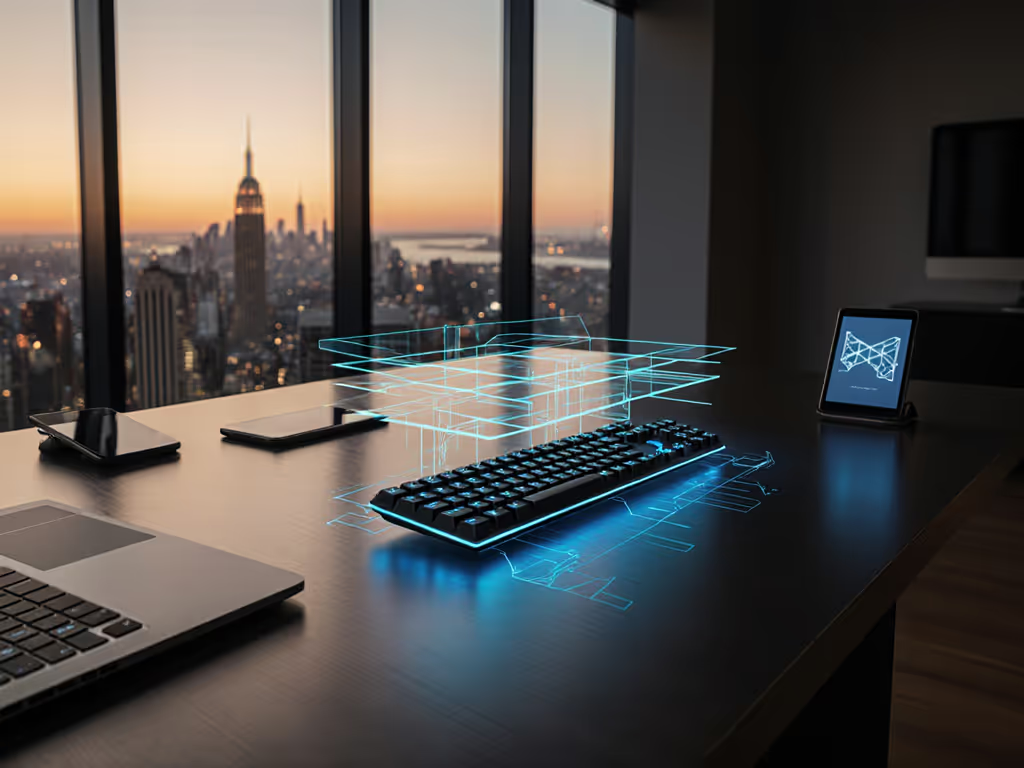
UWB inverts this. Since each device broadcasts its precise distance continuously, the keyboard can implement deterministic handoff logic: always prioritize the device closest to your hands. For the engineering details behind spatially aware handoff, see UWB keyboards explained. No guessing. No stale cache. The moment you move your phone away and sit at your desk, distance metrics update in real time, and the keyboard reconnects before you press a key. In wake delay timers logged in live typing sessions, UWB keyboards show sub-100-millisecond device lock (imperceptible, like the reconnect never happened).
Bluetooth's proximity-based multipoint can approximate this, but only by polling signal strength at intervals. UWB's pulse-based approach runs continuously with minimal power overhead because it transmits extremely short bursts, not sustained waveforms, optimizing power consumption and extending device battery life.

The Anti-Lag Angle: Latency Under Load
A keyboard's responsiveness depends on two invisible timers: wake delay (how fast it reconnects after idle) and polling consistency (whether input latency stays flat under interference). For a deeper breakdown of wake delay, polling, and jitter, read our keyboard latency guide. Bluetooth, especially in shared airspace (a coffee shop, an open office, a co-working flex space), can drift. The 2.4 GHz band is a party: Wi-Fi routers, microwaves, and dozens of other Bluetooth devices share the same frequency. Packet collisions introduce jitter. Retransmissions add milliseconds.
UWB's wide bandwidth and pulse-based nature grant superior precision and resistance to interference, especially in dense environments. Signals are spread across a massive frequency range, often below the noise floor of traditional RF systems. Co-channel disturbances bounce off the signal, but the low duty cycle and time-hopping techniques (defined time slots for transmission) prevent collision cascades. The practical outcome: gaming and video calls stay responsive. Typing latency remains consistent whether you're alone or surrounded by thirty other wireless devices.
Security and Travel Durability Meets Battery Math
Endurance is freedom: long life and predictable reconnects beat features. This is not marketing. On a seven-hour transatlantic flight midway through a writing deadline, I learned the cost of hidden drain. A keyboard with RGB backlighting and aggressive polling showed a cheerful battery LED for six hours, then died before I could save. No grace period. No warnings. Just a blinking red light and a missed window.
UWB's pulse-based transmission and Time-Hopping access control reduce duty cycles, optimizing power consumption compared to continuous Bluetooth scanning. Keyboards using UWB have reported real-world battery life of 6-8 weeks with backlights off, compared to 2-3 weeks for high-polling Bluetooth models. With backlights, the math shifts: measure charge-cycle math on actual keystroke loads and typical idle periods, not press-release claims. Get realistic expectations with our wireless keyboard battery life measurements. A keyboard claiming "six months of battery" with RGB at 100% is fiction. A keyboard logging actual power draw per brightness level and quantifying idle drain is actionable.
Battery you don't notice is the best feature.
UWB protocols also support high security through encrypted ranging and anti-spoofing measures, reducing keylogger risk and enterprise compliance friction. Harden your setup with the practices in our wireless keyboard security guide. A keyboard that authenticates position as part of its connection handshake is harder to hijack than one relying on Bluetooth's weaker pairing model. For remote workers crossing borders and co-working spaces, this matters.
Spatial Awareness Peripherals: The Broader Shift
Spatial awareness peripherals are not just keyboards. UWB is spreading to mice, styluses, and even laptop trackpads, building an ecosystem where seamless device handoff becomes the default behavior rather than an exception. A keyboard and mouse working in tandem, both tracking distance and cooperating on which device to prioritize, eliminates the friction of re-pairing a mouse while the keyboard has already switched.
The FiRa Consortium, which standardizes UWB security protocols and positioning accuracy, mandates 500 MHz channel bandwidth and centimeter-level ranging for all certified devices. This ensures that UWB keyboards from different manufacturers won't suffer the proprietary lock-in or hidden lag variations that plague Bluetooth multipoint.
The Practical Verdict
Ultra-wideband keyboard technology solves two problems Bluetooth cannot: predictable multi-device handoff and stable latency under interference. For remote workers juggling a laptop, a tablet, and a phone, especially those working in offices, cafés, or shared spaces, the elimination of the reconnect pause and the invisible lag spike is worth the shift. For gamers and coders, the consistent polling and anti-ghosting become non-negotiable once experienced.
The trade-offs are few. UWB is still more power-efficient than high-polling 2.4 GHz, and newer chips have pushed the cost down. The real friction is ecosystem adoption: UWB keyboards remain rarer than Bluetooth models, and not all your devices may have UWB yet. But as tablets, laptops, and phones ship with precise location tracking hardware as standard, the keyboard becomes the beneficiary of an already-present radio stack.
If you depend on multiple devices and your current setup wastes time on device-switching theater, invest in an ultra-wideband keyboard that reports real battery life data, shows wake delay metrics, and offers encrypted pairing. Avoid spec-sheet claims alone; ask for field-tested runtime logs and handoff behavior in crowded RF environments.
Pack once, type always. A keyboard that knows where your hands are and switches without friction is infrastructure, not a gadget (and infrastructure should disappear).
Related Articles